| Past continuous |
|
|
|
You have to use the auxiliary verb be + V-ing to form a continuous tense. Therefore, if you want to form the past continuous of a verb, you have to put the auxiliary verb be in the past and the main verb in present participle (V-ing). |
|
The usual structure of a question in English is: ...Aux. verb + S...? Therefore, all you have to do in the interrogative form is put the auxiliary be before the subject. |
USES
The past continuous tense is used mainly:
in descriptions:
It was a very dark night. It was raining heavily, the wind was blowing...
At 8 o'clock Paul was having breakfast.
We can use a verb in the simple past tense instead of a time expression: the action in the past continuous started before the action in the simple past and probably continued after it:
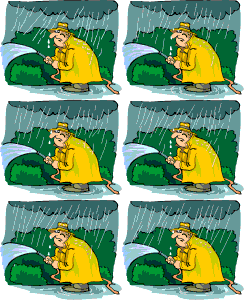
Henry was watering the garden when it started raining. ----------X- (--------- = water) (X = start raining) We do not know when the action expressed by "water" started or finished. We only know that this action was in progress when it started raining. Although we presume that it stopped after it started raining.
|
|